EXHIBITION “A JOURNEY THROUGH THE 19TH CENTURY” AT PRINCE MILOŠ’S RESIDENCE
Ауторски тим: кустоси историчари Борис Марковић, Срђан Бељић и Никола Миликић
15 August 2025 –
On Friday, 15 August 2025, at 11:00 a.m., the thematic exhibition A Journey Through the 19th Century was opened at Prince Miloš’s Residence in Topčider. Following introductory remarks by Dr Dušica Bojić, Director of the Historical Museum of Serbia, and curator Srđan Beljić, one of the exhibition’s authors, the exhibition was officially inaugurated. The exhibition was prepared by a curatorial team consisting of historians and curators Boris Marković, Srđan Beljić, and Nikola Milikić.
The exhibition was organized under the auspices of the Ministry of Culture of the Republic of Serbia, with the support of Telekom Srbija and Toyota Serbia.
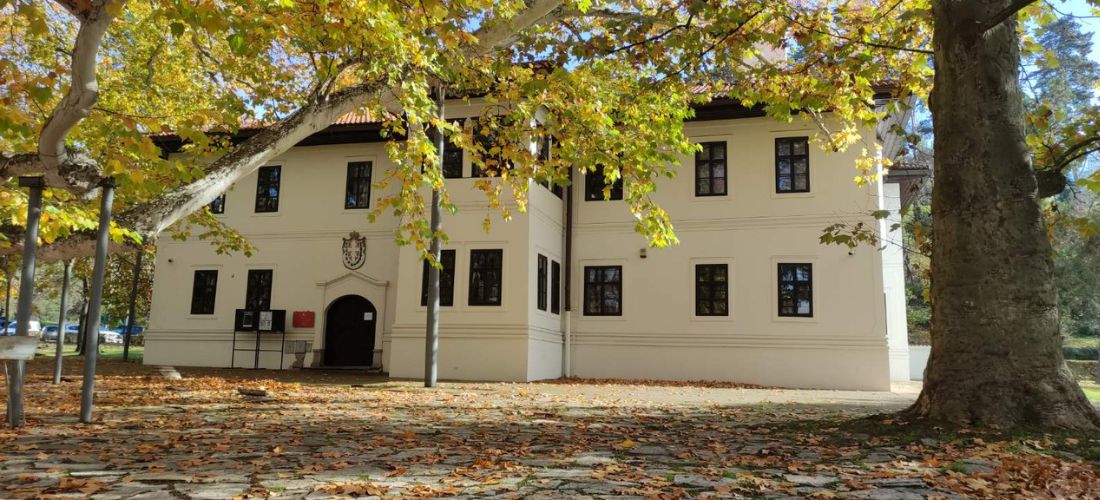
Prince Miloš’s Residence in Topčider, Photo: IMUS
The nineteenth century was an era of profound changes in science, technology, economics, politics, and social thought. One of the many transformative processes that marked the century was the development of travel, which evolved from an activity reserved for a small minority into a widespread aspect of everyday life across the world. Innovations such as the steamship and the railway made even the most distant regions accessible and enabled broader segments of society to embark on journeys. This combination of infrastructural, technological, and cultural changes is what we refer to as the travel revolution.
For the Serbian people, the nineteenth century was a period of major challenges and a long struggle for independence from the Ottoman Empire. Following the First and Second Serbian Uprisings, which laid the foundations of modern Serbian statehood, Serbian society underwent a process of modernization and state-building inspired by Western European models. Alongside many other innovations, the travel revolution gradually reached Serbia as well.
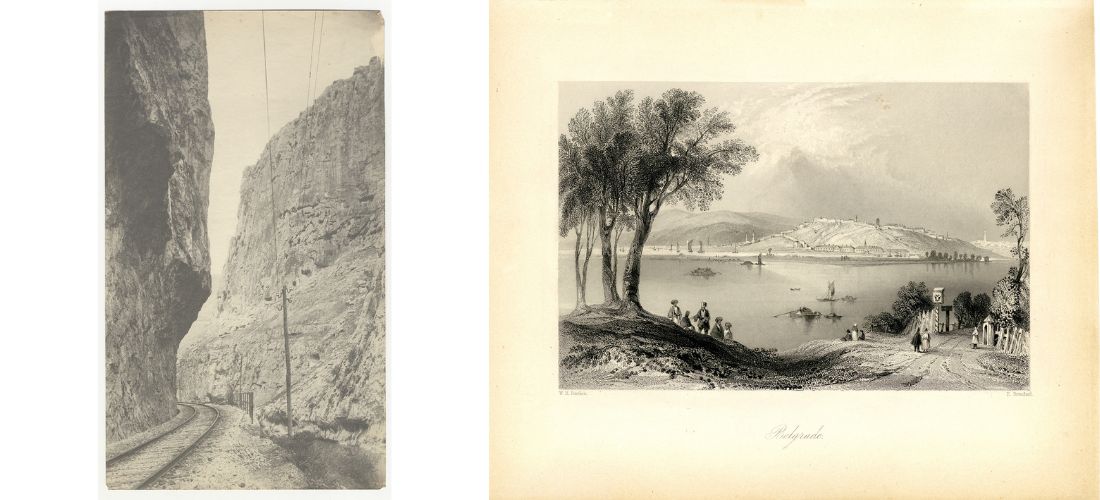
Đorđe Stanojević, Sićevo Gorge, positive photograph, late 19th – early 20th century; William Henry Bartlett, Belgrade (View of the Belgrade Fortress), lithograph, 1839
In order to provide a comprehensive approach to this complex topic, the exhibition authors conceived the display as three separate sections. The first explores the technological and infrastructural developments that laid the foundations for modern travel, as well as the pace at which these changes reached Serbia. The second section is dedicated to Serbian travellers of the nineteenth century, their motives for travelling, and the impressions they brought back from their journeys. As the focus is placed on the reasons for travel, visitors encounter Serbian refugees, merchants, pilgrims, state scholarship recipients, and the first tourists. The third section examines foreign travellers who visited Serbian lands during the nineteenth century and recorded their experiences in diaries and numerous travel accounts.
The exhibition A Journey Through the 19th Century features a large number of original artefacts from the Historical Museum of Serbia that testify to the development of travel in Serbia and throughout the world during the nineteenth century. Among the exhibits are travel documents belonging to Serbian refugees who sought refuge in the Austrian and Russian Empires following the collapse of the First Serbian Uprising in 1813, as well as the passport of Prince Mihailo Obrenović. The exhibition is further enriched by multimedia content.
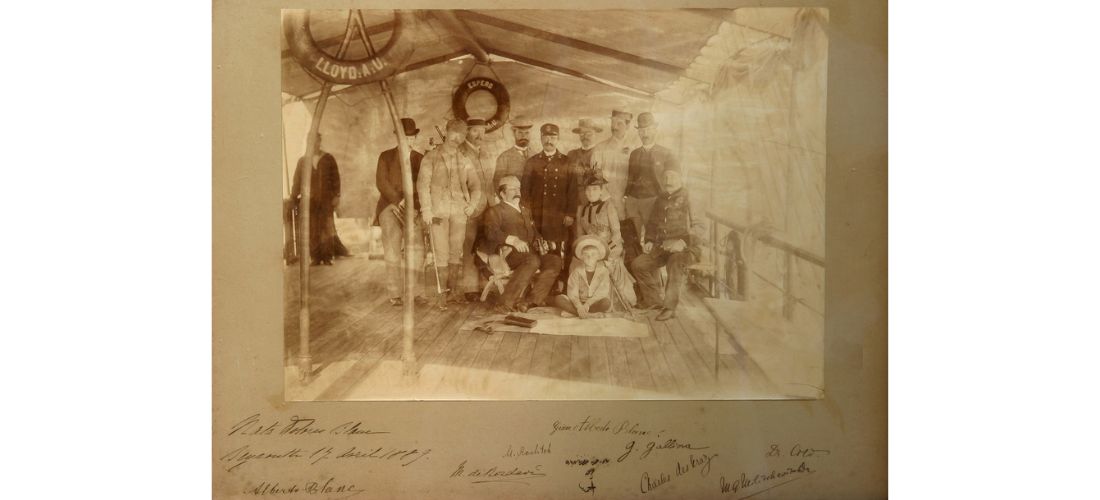
King Milan with his entourage and fellow travellers aboard a ship on his journey to Jerusalem, photograph, 1889
The second and third sections of the exhibition are presented on two separate touchscreen displays, allowing visitors to independently explore the stories of Serbian travellers and foreign travel writers. These interactive segments were developed by Josipa Tivanovac, while the exhibition design, visual identity, and accompanying catalogue were created by Iva Jotić Lubura.
A special segment of the exhibition takes the form of an artistic installation featuring a distinctive signpost and models of the most representative means of transportation of the nineteenth century – a carriage, a locomotive, and a steamship. This installation was created by the artist collective Stone Paper Scissors. The exhibition is also enriched with video materials provided by the State Audiovisual Archive of Serbia, the Yugoslav Film Archive.
The exhibition A Journey Through the 19th Century is displayed in a dedicated section of Prince Miloš’s Residence reserved for thematic exhibitions, while the permanent exhibition Serbia 1804–1903 is presented in the remaining rooms.
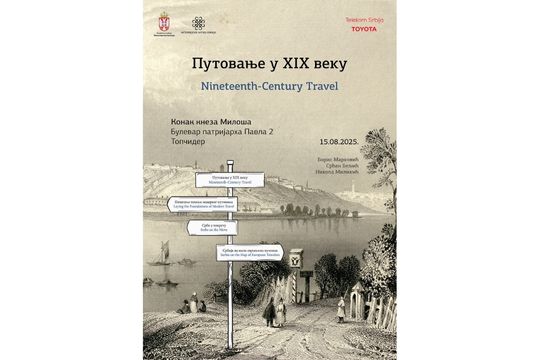
Poster for the exhibition A Journey Through the 19th Century
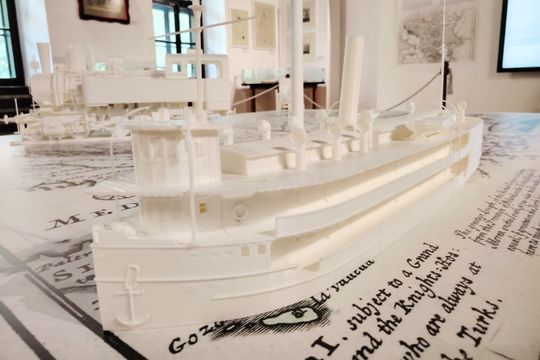
Exhibition detail, A Journey Through the 19th Century, Photo: IMUS
See you at the Residence!